

Last updated: 18:15 GMT, Friday 13 November 2026. Microsoft now says it has fixed the underlying problem and reports broad recovery, but it is still restoring service for some customers and has not declared the incident closed. We will update this page as Microsoft reports progress.
A global Microsoft 365 outage that began on Thursday afternoon has left millions of people around the world unable to open their email or send messages. Outlook, Teams, Copilot and other Microsoft 365 apps were hit, and by Friday the problems had stretched into a second day. Hospitals, courts, schools, train operators, airlines, stock markets and government departments in at least a dozen countries have reported disruption.
Here is what happened, where it hit hardest, what caused it, and where things stand now.
The outage at a glance
| Started | Late afternoon UK time, Thursday 12 November 2026. Microsoft puts the start at 16:17 GMT. User reports built up between about 16:00 and 18:00 GMT |
| Services hit | Exchange Online email (Outlook on the web, desktop and phone), plus Teams calendars and meetings, Copilot, Intune and other Microsoft 365 apps that rely on email |
| Reach | About 140,000 reports from 74 countries and territories on Downdetector by Thursday evening |
| Cause | Not a cyber attack, says Microsoft. It blames a problem during an earlier network capacity upgrade, which surfaced after a recent network change. Full post-incident report still to come |
| Microsoft incident IDs | EX1550543 (Exchange Online) and MO1550821 (Microsoft 365 services that depend on it) |
| Status now | Mostly recovered, not yet closed. At about 17:20 GMT on Friday, Microsoft said it had addressed the underlying issue and saw broad recovery and stability. It is still restoring service to the remaining customers and regions |
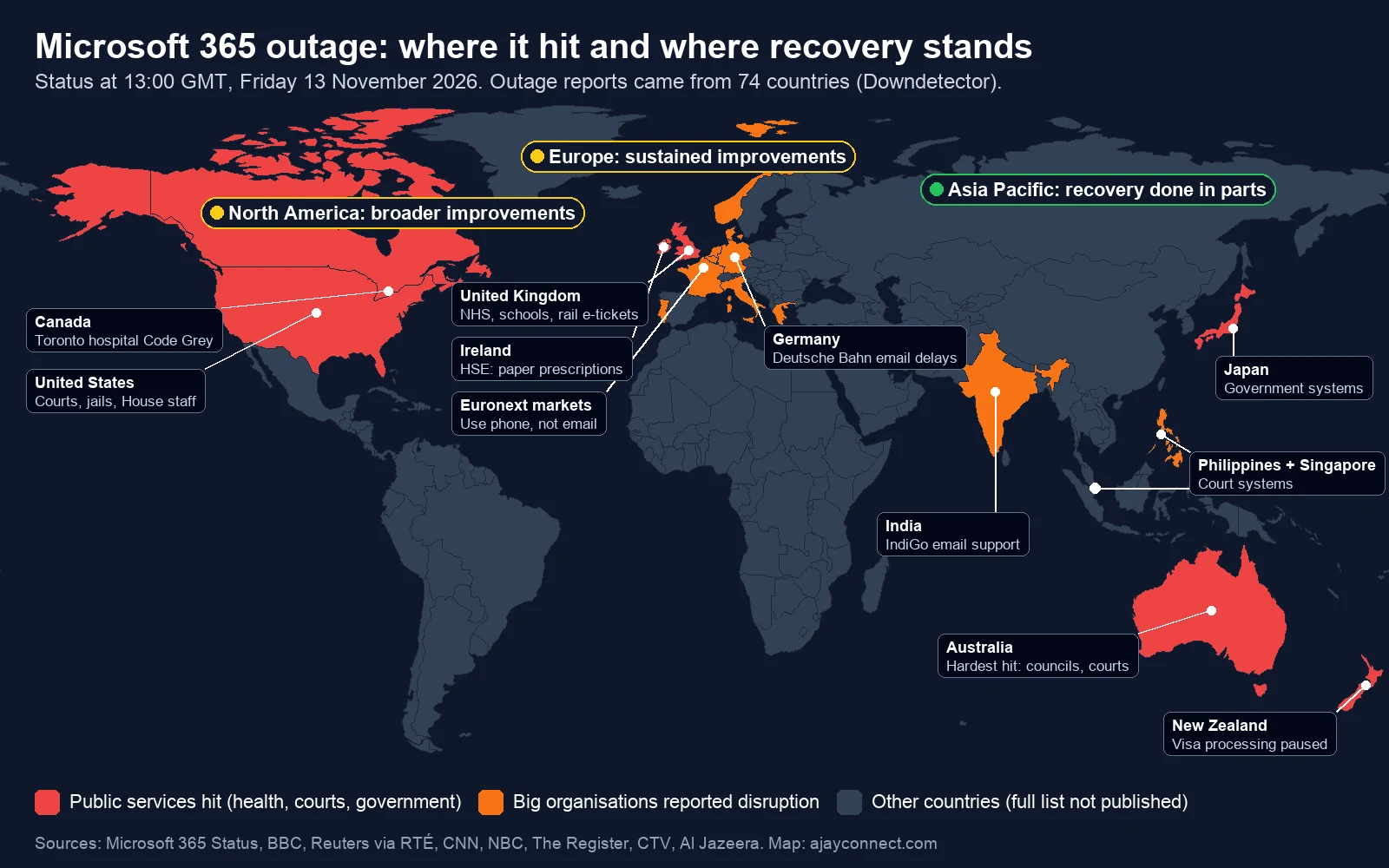
World map: where the outage hit
Timeline: how the outage unfolded
Times are in GMT (UK time). Some are approximate because news reports and Microsoft’s own updates give slightly different times.
| When (GMT) | What happened |
|---|---|
| Thu 12 Nov, about 16:00–18:00 | Users start reporting that they cannot open Outlook. In Ireland and the UK, Downdetector first shows a spike in Teams reports. |
| Thu evening | About 140,000 people in 74 countries report problems on Downdetector. Microsoft says it is investigating problems with Exchange Online mailboxes. |
| Thu evening | Microsoft says the extra load is not caused by more traffic. A number of servers became unexpectedly unavailable, straining the rest. |
| Overnight | Servers brought back into service become unresponsive again once traffic reaches them. Microsoft limits some types of traffic while it investigates. |
| Overnight | Microsoft says its actions so far have not given the relief it expected. It finds a core process on the affected servers is being overwhelmed. |
| Fri 13 Nov, early morning | Microsoft says there is no indication of malicious activity. |
| Fri, about 07:30 | Microsoft reports positive results for server stability after applying a fix to part of its infrastructure. |
| Fri, about 09:15 | Microsoft reports early stabilisation and extends the email timeout window to 48 hours, so delayed messages are kept rather than bounced. |
| Fri, about 11:00 | Recovery actions completed in parts of Asia Pacific. Mailbox access and delayed email processing improve. |
| Fri, about 12:00–13:00 | Microsoft reports encouraging progress in Europe and broader improvements in North America. Some users still see intermittent problems. |
| Fri, about 14:15–14:35 | Microsoft says email queues are significantly reduced and approaching normal levels. Some users may still see intermittent access problems or delayed email. |
| Fri, about 15:15 | Microsoft executive Charles Lamanna says the company regrets the impact on customers and is reviewing what happened and how to prevent it happening again. |
| Fri, about 17:00 | Hong Kong Exchanges and Clearing says its email is affected, but all market operations are running as normal. |
| Fri, about 17:20 | Microsoft says it has addressed the underlying issue and is seeing broad recovery and stability. It gives a first cause: a problem during an earlier network capacity upgrade that surfaced after a recent network change. It is still restoring service to remaining customers and regions. |
Global impact, country by country
Microsoft has not said how many customers were affected. These are the organisations that publicly reported disruption.
| Country | Who was affected | What happened |
|---|---|---|
| 🇬🇧 United Kingdom | NHS, schools, Ofsted, Ofqual, Department for Education, National Rail, police forces | Some NHS operations were cancelled and staff switched to paper records. Patients were told to attend appointments as normal and call 999 in an emergency. Electronic prescriptions had problems. National Rail warned that emailed tickets might not arrive. The Bank of England said its critical operations were running normally. |
| 🇮🇪 Ireland | HSE and Healthmail | Email stopped flowing. GPs and pharmacists were told to use paper prescriptions. |
| 🇺🇸 United States | House of Representatives, courts, sheriffs, cities, hospitals | House staff lost a day of legislative work. A Colorado jail had to take bond payments in person. Courts in Los Angeles and Texas warned of delays, and several Californian cities said email was down. |
| 🇨🇦 Canada | Unity Health Toronto, University Health Network, Via Rail, City of Toronto, Alberta courts | Unity Health Toronto, which includes St. Michael’s Hospital, declared a “Code Grey” for infrastructure failure, though it said patient care was not affected. Via Rail warned passengers that trip emails might not arrive. |
| 🇦🇺 Australia | Councils, state and federal agencies, ASIO, federal police, courts, schools, Queensland Health | Described as one of the hardest-hit countries. Many public bodies said they could not be reached by email. The Victorian government warned about scammers using the confusion. |
| 🇳🇿 New Zealand | Immigration New Zealand and other public agencies | Immigration New Zealand paused processing of visa applications until service stabilises. Agencies switched to manual methods. |
| 🇯🇵 Japan | Government IT systems, Kyushu and Waseda universities, Credit Saison | The government’s shared IT platform was disrupted. Some offices went back to phone and fax. |
| 🇵🇭 Philippines | Supreme Court | Warned that email and transaction responses may be delayed. |
| 🇸🇬 Singapore | Courts and government | Court systems reported email problems. |
| 🇮🇳 India | IndiGo, Air India | IndiGo’s email support was disrupted. Air India said flights were not affected and it rerouted email so customer queries still arrived. |
| 🇩🇪 Germany | Deutsche Bahn | Severe email delays made it hard to send timetables for diverted trains. |
| 🇭🇰 Hong Kong | Hong Kong Exchanges and Clearing (HKEX) | HKEX said its email services were affected. Trading and other market operations carried on as normal. |
| 🇪🇺 Europe-wide | Euronext (Paris, Amsterdam, Brussels, Lisbon, Oslo, Athens, Milan markets), Aviva, Maersk | Euronext asked listed companies to phone instead of email, because its listings team was not receiving messages. |
The outage also affected services that many businesses depend on, including OpenAI’s ChatGPT and Anthropic’s Claude. In Australia, experts warned that the lost work could cost billions of dollars, with small businesses hit hardest.
What caused the Microsoft outage?
Microsoft has said clearly that this was not a cyber attack. On Friday afternoon it gave its first explanation of the cause. It said the incident was “introduced by an issue during an earlier network capacity upgrade” that surfaced after a recent network change. It called it a technical issue, not related to cyber or to AI agents.
Microsoft’s earlier updates describe the chain reaction that followed:
- A number of servers that run Exchange Online became unexpectedly unavailable.
- The remaining servers had to carry their load, and a core process on them, which sets up secure connections, became overwhelmed.
- Servers that Microsoft brought back online failed again as soon as normal traffic reached them, which is why the outage dragged on for so long.
Microsoft paused all changes to its systems, rerouted and limited traffic, added capacity and rolled back a recent network configuration change. It says it restored services gradually and checked stability at each stage, which took longer but made the recovery more stable. Microsoft has not yet published the full technical detail. Australia’s Home Affairs Minister said Microsoft told him it was a faulty update, but Microsoft itself has not used those words. The outage came two days after Microsoft’s monthly Patch Tuesday security updates. Microsoft has promised a full post-incident report once its review is complete.
Where is it now? Recovery by region
| Region | Latest status (13 Nov, GMT) |
|---|---|
| Worldwide | 🟡 About 17:20: underlying issue addressed, with broad recovery and stability. Microsoft is still restoring service to remaining customers and regions, and has not declared the incident closed |
| Asia Pacific | 🟢 About 13:00: recovery actions completed in parts of the region, with encouraging recovery signals. Japan described as comparatively stable |
| Europe and UK | 🟡 About 13:00: sustained improvements across much of Europe. Email queues were close to normal by mid-afternoon |
| North America | 🟡 About 13:00: broader improvements, but intermittent problems still possible |
Microsoft has not given a new region-by-region update since about 13:00 GMT. Its later statements cover the whole service. It has not named the regions still being restored, and it has not given a time for full recovery. If your email is still slow, it may arrive in batches with old timestamps as the last of the backlog clears.
Is my email lost?
Probably not. Microsoft says email delivery has been delayed, not lost, and it has extended its email timeout window to 48 hours so delayed messages are kept. Mail servers that sent you email will also keep retrying for some time.
The main risk is a bounce. If the sender’s mail server gives up before your mailbox is back, they may get an error message saying it could not be delivered. If you are waiting for something important, ask the sender to check.
What to do if you are affected
If you use Outlook or Teams at work
- Do not resend emails that are stuck. They are queued and should go out as service returns, and resending can create duplicates.
- Use the phone or another channel for anything urgent.
- Check your Junk folder once mail starts arriving, as a backlog can arrive all at once.
- Watch out for scams. Fraudsters often send fake “reset your Microsoft password” or “verify your mailbox” emails during outages. Microsoft will not ask you to sign in through a link to fix this.
If you run IT for an organisation
- Follow incidents EX1550543 and MO1550821 in the Microsoft 365 admin center, or the public status page at status.cloud.microsoft.
- Expect delays in scripts and apps that read mail or calendars through Microsoft Graph, and retry rather than treat them as lost data.
- Write down when your users lost service, how many were affected and when it came back. You will need this if you claim a service credit under Microsoft’s service level agreement, which promises 99.9% monthly uptime. Credits are not automatic, so you have to raise a request.
How does this compare with past outages?
This is one of Microsoft’s longest email outages in years. About 25 hours passed between the start and Microsoft saying it had addressed the underlying issue, and the incident is still not formally closed. Reports have compared it with the July 2024 CrowdStrike incident, when a faulty security update crashed millions of Windows computers. This time computers kept working, but email and calendars for organisations that rely on Microsoft 365 stopped. In the UK, defence minister Luke Pollard called for greater resilience against technology failures.
Frequently asked questions
Is Outlook down right now?
As of 18:15 GMT on 13 November 2026, Outlook is working again for most people. Microsoft says the underlying issue is fixed and reports broad recovery, but it is still restoring service for some customers and has not declared the incident over. Check Microsoft’s service status page for the latest.
Was the Microsoft outage a cyber attack?
No. Microsoft says it was a technical issue, not related to cyber or AI agents. It blames a problem during an earlier network capacity upgrade, which surfaced after a recent network change.
Which Microsoft services were affected?
Mainly Exchange Online email, used by Outlook on the web, desktop and phones. Teams calendars and meeting scheduling, Copilot, Intune and other apps that rely on email were also affected. Teams chats and calls mostly kept working.
Are personal Outlook.com accounts affected?
Most reports concern work and school Microsoft 365 accounts. Some Outlook users at home also reported problems on Downdetector.
Will I get compensation?
Home users generally will not. Businesses on Microsoft 365 plans may be able to claim a service credit if uptime fell below 99.9% in the month, but they need to apply through the Microsoft 365 admin center or their reseller.
Sources
- Microsoft 365 service status and @MSFT365Status on X
- NBC News live updates
- The Register
- RTÉ News
- Al Jazeera
- CTV News Toronto
- Insurance Business
- CNN live updates
- ABC7 News live updates
- Windows Central
- LazyAdmin
- Wikipedia: 2026 Microsoft outage
This article is based on Microsoft’s public updates and news reports at the time of writing. Details may change as Microsoft publishes its post-incident report.